Formula 1 seasons last more than twenty races, but championship battles often are predictable surprisingly early. After only two races, fans already speculate about who will become world champion. But how much information do the first races actually contain?
The Formula 1 season has just started, and after a dominant performance by Mercedes at the Australian and Chinese Grands Prix, one might wonder what the chances are that a Mercedes driver will become world champion. This season is particularly interesting because the 2026 regulation changes introduced new power units, new aerodynamics, and new chassis. Since teams couldn’t rely on last year’s car concept, the competitive order of this year was expected to change.
In Formula 1, the first races of the season reveal more about competitiveness than one might think. Unlike many other sports, performance in F1 relies heavily on the quality of the car. By the time the first race has taken place, teams have already developed their car for months, and the teams that lack performance often have trouble catching up. Therefore, early races usually provide a strong indication of which drivers and teams have the pace to fight for the championship.
To analyse the results of the first two races, I collected data from 2010-2025. For each driver-season observation, the dataset contains the finishing position and points scored in the first two races, as well as the final championship result. Sprint races are excluded from the analysis, since only one sprint weekend occurred in the entire dataset and the impact on points scored is relatively small. Using this dataset, we estimate how results of the first two races affect the probability of becoming world champion.
Since the outcome variable of being champion is binary, we estimate a logistic regression model.

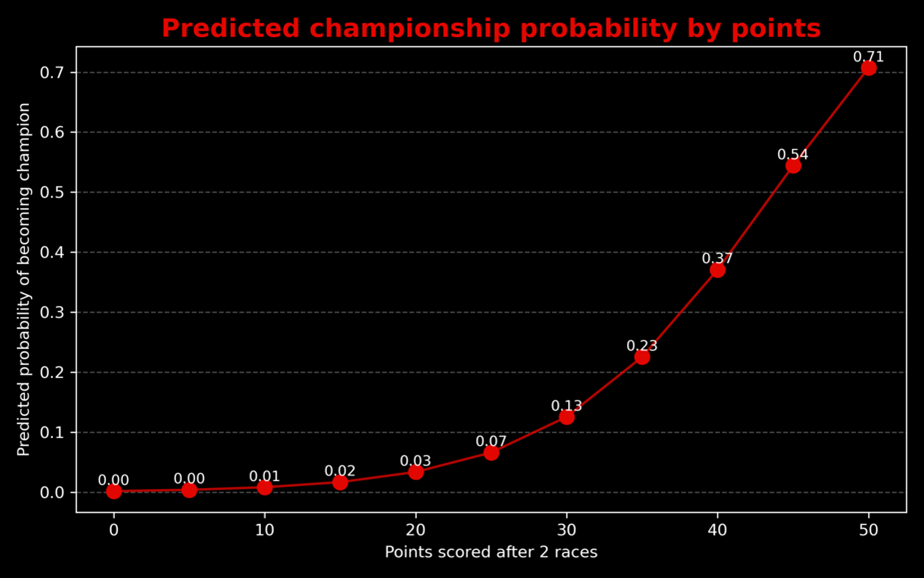
The model estimates the impact of points scored in the first two races on the probability of becoming world champion. The relationship is strongly increasing. A driver who scores the maximum of 50 points in the first two races has a 71% chance of becoming world champion. In contrast, fewer points make the probability drop quickly. Having two strong race results can hardly be a coincidence, and this indicates that both the driver and the car are capable of competing.
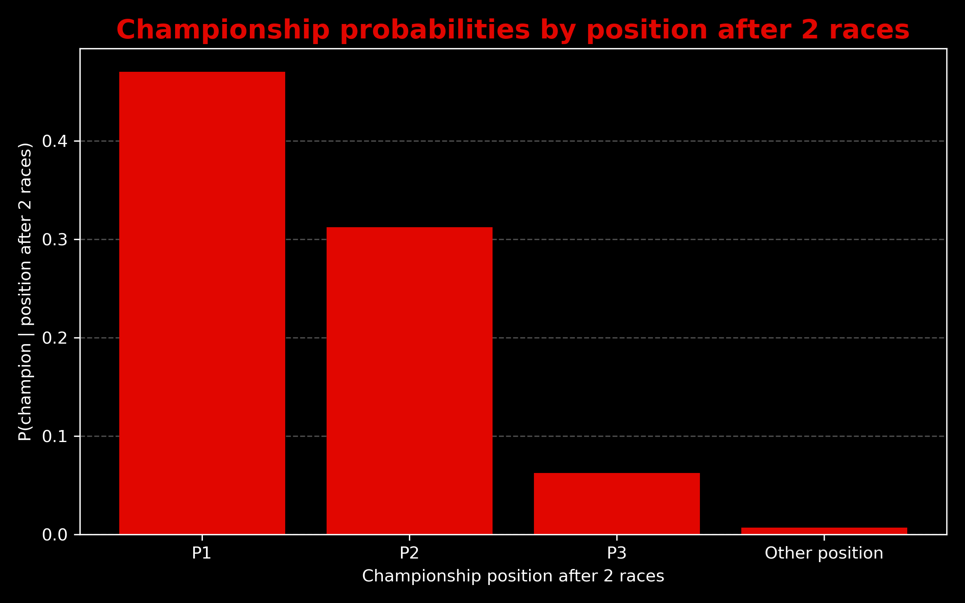
Another way to look at the data is to calculate the probability empirically. The conditional probability can be calculated as:

Looking at the graph we can see that the probability of becoming champion drops sharply in position after two races. More than 75% of championships were won by drivers who were first or second in the standings after two races, and lower positions have far lower probabilities.
The main takeaway here is that the competitive order in F1 is visible very early in the season. When a team has a dominant car, it is difficult for competitors to close the gap. Even though teams still bring upgrades to their cars during the remainder of the season, the damage is already done, and most teams will always be one step behind.
Finally, we can compare these estimated probabilities with prediction markets. For example, Polymarket currently assigns George Russell a 59% and Kimi Antonelli an 18% probability of becoming world champion. Compared to Polymarket, our model tends to assign a lower probability to George and a higher one to Kimi. This is probably because it is only Kimi’s second season in F1, which makes George the favourite.
Even though the Formula 1 season may last more than twenty races, it becomes very informative after just two. A simple analysis already provides substantial information about which drivers are most likely to become world champion. While there can be plenty of surprises during the remainder of the season, the first two races already separate the likely contenders from the rest of the grid. In Formula 1, the championship is not decided after two races, but by that point we already have a very good idea of who might win it.
Github: https://github.com/albertpierik/f1-championship-analysis